Owasco Lake foam, invasives and more covered at symposium

The Owasco Watershed Lake Association believes that action creates hope. Those who drink the water from Owasco Lake can’t sit around and hope the lake remains healthy. In that case, "hope" is a verb. Members of OWLA treat hope as a noun, a thing that is created by taking action! The Bob Brower Scientific Symposium reported on the challenges we face to preserve our drinking water, and the actions in place to create hope for the future of Owasco Lake!
From 9 a.m. to noon March 14, 100 attendees heard four presentations of vital importance, and clearly, we realize it takes a village to create hope!
Have you wondered what we are doing to create hope for Owasco Lake?
Dr. Adam Effler (director, Owasco Lake Watershed Management Council) and Jesse Lloyd (watershed inspector) presented an overview of 2025-26 projects and accomplishments. The management council annual report describes the progress made to address the causes of harmful algal blooms (HABs). By creating natural filters to stop the flow of pollutants into streams and ditches, through stream bank and road ditch improvements, planting buffers and site cleanup of chemical storage, important and effective protection of water quality is achieved. The council collaborates with private citizens, municipalities, the Owasco Watershed Lake Association, the Cayuga County Soil & Water Conservation District and others to fund the work we face together. Because existing regulations are old (1984), and cyanobacteria in harmful algal blooms have been increasing dramatically since 2016, we have sued the New York State Health Department to have updated regulations approved.
You can see the hope in “before and after” pictures of improvements in the management council's annual report! Their website is owascoinspection.org. Find them on Facebook too!
How does Auburn create hope for our drinking water?
Seth Jensen, director of municipal utilities for the city of Auburn, explained the actions it is taking to preserve and provide safe drinking water. To modernize infrastructure, Auburn has spent millions of dollars to adapt the filtration and treatment of microcystin at the pumping station, where millions of gallons of water are piped out of Owasco Lake into Auburn every day. Auburn and Moravia have also spent millions to update their wastewater treatment plants to accommodate “100-year storms” (which have happened two times in the last 10 years!) The wastewater treatment plants release clean, drinkable water back into the Owasco Inlet and river to flow north to provide drinking water for Auburn and surrounding communities.
The costly upgrades were required to protect against the new toxins we have detected, and to accommodate the impact of storms. About 45,000 people drink Owasco Lake water every day, therefore Auburn acts diligently through constant vigilance to preserve our drinking water!
Have you noticed the foam on the lake? Is there hope?
Foam is new to our lake. Rick Smith, of Global Aquatic Research, studies global waterbody chemistry. Rick earned a doctorate in chemical oceanography from Texas A&M University in 2011, and has recently studied the formation of foam on Canandaigua Lake. Chemicals in a very thin top layer of our lake water combine with air to create the foam. Smith’s chemical analysis finds the foam contains high levels of bacteria. The process of forming the foam is a chemical reaction that captures bacteria and other nutrients. Canandaigua Lake has had foam cover large portions of the lake. Owasco Lake has had miles of foam which collect along the shoreline, or form a line in the middle of the lake!
The chemicals that foam contains relate to harmful algal blooms. If you see a long white line in the middle of the lake, or thick white stuff along the shore of the lake or the river, it is foam and follows a harmful algal bloom. The hope of controlling this new phenomenon exists; however, it requires every effort we are now making to be taken more seriously and with greater diligence! We do not yet know what Band-Aid treatments can be done. Research, experimentation and collaboration needed to determine how to cure the problem. Can foam be removed or dissolved? Very similar to the experimentation needed to cure the hemlock woolly adelgid threat, experimentation is needed urgently to arrest lake degradation! Thanks to Rick Smith for sharing his research. His vital work gives us hope!
Have you seen a stand of hemlock trees that are sick and dying? There is hope!
The hemlocks are suffering from an invasive insect called the hemlock woolly adelgid. The loss of hemlocks presents a real threat to the Owasco watershed because many hemlock trees hold the soil on our hillsides, gullies and gorges. If they die, the erosion would seriously threaten our water quality. Matt Del Buono, an extension aide with the Cornell University Hemlock Initiative, presented the work being done to introduce natural predators of the woolly adelgid. There are two bugs, who are natural predators, that have been introduced in this area. They seem to be adapting, and their presence might feed upon woolly adelgid enough for the hemlocks to survive. Matt is hopeful that the two natural predators can reduce the harm of hemlock woolly adelgid without causing unintended consequences. So far, the research is promising.
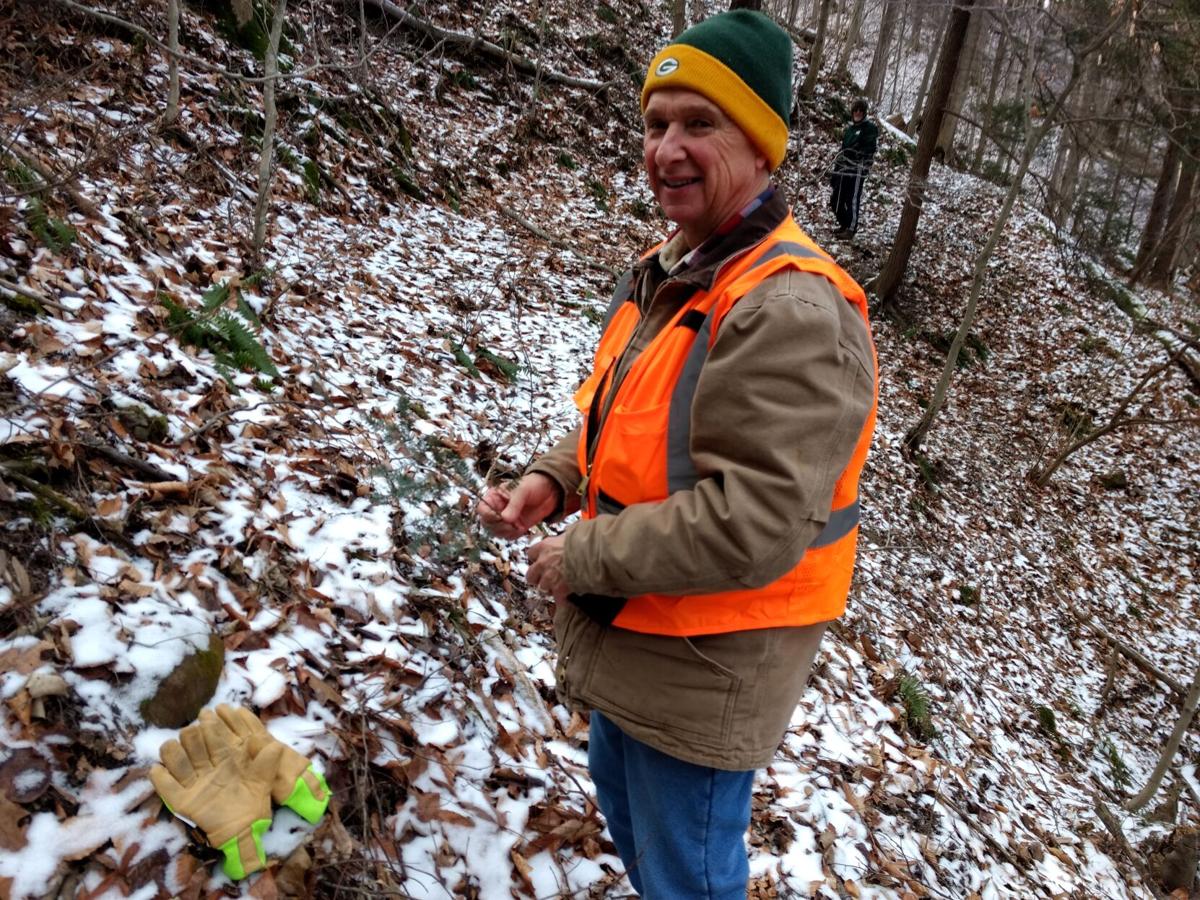
Carl Weber, of the Owasco Watershed Lake Association Board of Directors, presented the role OWLA has played to address the woolly adelgid problem. Action starts by finding and contacting land owners to get permission to go on to their property. Next, it is necessary to hike the land and find the trees that are most crucial to watershed protection. Carl reported that 11,000 trees have been treated with insecticide. A certified treatment specialist, who is able to rappell down a cliffside to reach the trees, sprays the insecticide. Over $200,000 has been spent so far, and a recent grant provides $75,000 additional funding for the next round of insecticide treatment. Our hope is that soon the natural predators of woolly adelgid reduce the damage and the need for insecticide treatment and greatly improve the survival of hemlocks. There is hope!
Read more articles